Die Grundlagen des Barocktanzes – Sarabande pour une femme und Cotillons
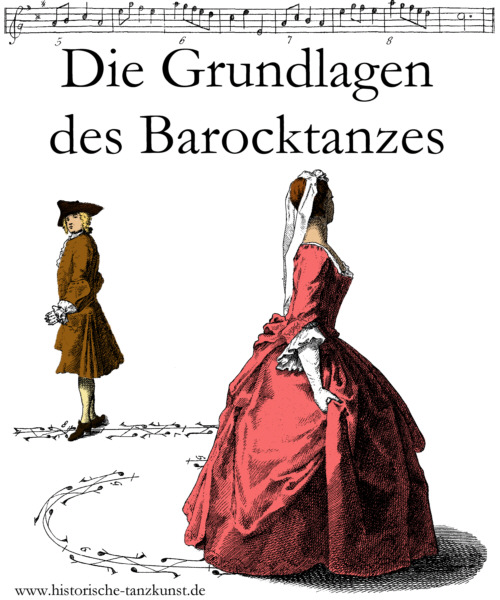
Die Reihe „Grundlagen des Barocktanzes“ bietet einmal im Monat in Frankfurt am Main die Gelegenheit, sich ein solides Fundament in der barocken Tanztechnik zu erarbeiten. Der Unterricht ist auf Anfänger (mit und ohne Vorkenntnisse) ausgerichtet, ein Einstieg in die Reihe ist jederzeit möglich. Der Kurs ist natürlich auch für Tänzer bis zu einem mittleren Niveau im Barocktanz geeignet, die ihn zur Konsolidierung ihrer Technik nutzen können. Neben dem Erlernen von Tanztechnik und den verschiedenen Choreographien steht auch immer etwas Theorie auf dem Programm. Jeder Tanztag ist in zwei Teile aufgeteilt, die auch unabhängig voneinander buchbar sind. Am Nachmittag widmen wir uns den einfacheren Gruppentänzen, insbesondere den Contredanses, wie sie heute gerne auf „Barockbällen“ getanzt werden. Dies beinhaltet die dazugehörige zeitgenössische Schritttechnik und einen systematischen Unterricht der verschiedenen Figuren. Am Vormittag stehen jeweils Teile eines Solo(paar)tanzes auf dem Programm; Tänzer, die bereits entsprechende Grundlagen im Barocktanz haben, können sich hier auch im Gebrauch der dazugehörigen Armbewegungen üben.

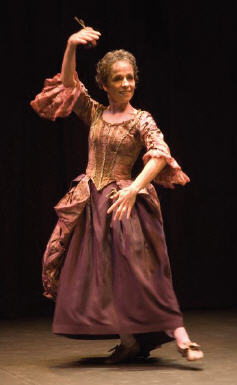
Am 14. Februar starten wir am Vormittag mit der Arbeit an einem Damensolotanz, der „Sarabande pour une femme“ (Pecour 1704). Ein Solotanz ist sicherlich nicht das Einfachste, was man im Barocktanz machen kann, schon gar nicht als Anfänger – aber dafür hat man keinen Partner, der einen stören kann, alle im Raum machen das Gleiche und blicken die meiste Zeit nach vorne. Die ausgewählte Sarabande ist natürlich einer der einfacheren Tänze aus diesem Genre. Im Schritttechnik-Teil stehen das Coupé und seine Varianten auf dem Programm, von dem in unserem Tanz reichhaltig Gebrauch gemacht wird.

Am Nachmittag widmen wir uns der französischen Form der Contredanses – den Cotillons. Im 18ten Jahrhundert waren sie überaus beliebt, auf heutigen Barock/Rokokobällen werden sie leider selten getanzt. Sie funktionieren nach dem Strophen-Refrain Prinzip – individuell für jeden Tanz ist der spezifische Refrain, für die Strophen bedient man sich aus einem kleinen Repertoire bekannter Figuren. Anders als bei den englischen Longways hat man hier seinen Partner an seiner Seite und die Paare bilden ein Quadrat.

Die Termine der Reihe im ersten Halbjahr 2016 sind der 17. Jan., 14. Feb., 13. März, 17. Apr., 15. Mai, 12. Juni, 9. und 10. Juli 2016. Weitere Informationen finden sich auf meiner Webseite www.historische-tanzkunst.de sowie im Flyer.

  • Workshop
  • Baroque
  • Beginner
  • Intermediates

Danz Vosolvia 20. Jubiläums-Sommertanzkurs - Festliche Ausgabe

ACHTUNG: Der Kurs ist ausgebucht.

Balletti auf Musik von Monteverdi, Kapsberger, Merula u.a.

Tänze zwischen 1580 und 1650 aus Italien/Spanien

für Fortgeschrittene. Kenntnis von Tanzschritten von Caroso und Negri sind erforderlich.

Das Tanzmusikrepertoire aus dem späten 16. Jhdt und Beginn des 17. Jhdts ist von ungeahnter melodischer Schönheit, rhythmischer Abwechslung und Dynamik.

Die Tanztechnik ist sicher dieser Komplexität gefolgt, aber leider ist der größte Teil dieser Choreographien niemals aufgeschrieben worden.

In unserem Jubiläumskurs stöbern wir in diesem Repertoire und choreografieren verschiedene Tänze mit der ausgebreiteten Tanztechnik, welche uns die Traktate aus Italien, Spanien und Frankreich aufzeigen.

Daneben genießen wir ein Glas Wein in einer heimischen Straußwirtschaft, erleben ein Festmahl in der Gutsschänke „Im alten Dorf“ in Dellhofen, und die übrigen Abende füllen wir mit Gesellschaftstänzen, Tanzvideos und Vorträgen.

Für den festlichen Abschlussabend am Samstag den 13.8. würden wir uns über mitgebrachte Kostüme aus der Zeit um 1600 freuen.

Kursgebühr: 500,- Euro incl. VP im DZ (EZ + 70,--Euro)

Kostenlose Schwimmbadnutzung nach Absprache

Anmeldung bis 1. Mai 2016 mit anhängendem Abschnitt an:

Lucie Schuck, Chablisstr. 35, 55430 Oberwesel

Tel. 06744/8327 oder per mail an

heribert_u._lucie-schuck@t-online.de

und gleichzeitiger Anzahlung von 300,-- €

Restzahlung bis 15.7.2016 Überweisung der Teilnahmegebühr auf das Konto des Bildungswerk Oberwesel

220 0020 BLZ 560 517 90 KSK Oberwesel BIC MALADE51SIM

IBAN: DE34560517900002200020

Maximale Teilnehmerzahl: 24 Teilnehmer

Die Reihenfolge der Anmeldung und Anzahlung entscheidet über die Teilnahme

Für Schäden, Unfälle und Verlust von persönlichem Eigentum kann keine Haftung übernommen werden

  • Workshop
  • Summer School
  • Renaissance
  • Early Baroque

CARNEVALE PRAHA 2016 - Baroque Nights at the Clam-Gallas Palace

Festival Carnevale Praha 29.1.  - 9. 2. 2016

The baroque nights at Clam-Gallas palace

MUSIC IN THE TIME OF ABUNDANCE

We invite you to the carnival series of Baroque concerts, which are part of the Program of Prague Carnival. Events are held from Friday, January 29th, till Fat Tuesday, February 9th 2016 , at the Clam-Gallas Palace, in the magnificent seat of the Bohemian Statesman and Habsburg Imperial Ambassador, Johann Wenzel von Gallas.

List of the performances:

  • FR 29.1. MASOPUST JUŽ NASTAL Soirée 20:00 - 21:15 h           
  • SA 30. 1.  IN THE GARDENS OF GODDESS POMONA Soirée 20:00- 21:15  h       
  • SU 31. 1. IL DOLCE TORMENTO Matinée 13.00 - 14:15 h             
  • SA6. 2. IN THE GARDENS OF GODDESS POMONA Soirée 20:00 - 21:15 h
  • SU 7. 2. IL DOLCE TORMENTO Soirée 20:00 - 21:15  h                    
  • TU 9. 2. VIVAT CARNEVALE Soirée 20:00 - 21:15 h

ADMISSION

Sector A / 1.200,-CZK / 1 person / 1. row concert + drink

Sector B / 900,-CZK / 1 person / 2. row concert + drink

Sector C / 600,-CZK / 1 person / concert

Anotation:

The concert programme "IN THE GARDENS OF GODDESS POMONA and IL DOLCE TORMENTO with subtitle "Music in the Time of Abundance" will consist of music by Claudio Monteverdi, his contemporaries and followers. Monteverdi's pioneering work, coming at the turn of the Renaissance and Baroque periods, contributed to the emergence of a new musical style (seconda practica) and laid the foundations not only of Baroque music, but also gave birth to a new musical genre - opera...

Vivat Carnevale / Long live Carnival

Carnevale alias Carnival used to be the highlight of the social season. Just for this period a number of the most famous musical works was composed in the past. The program will feature music from famous Carnival operas XVII. a XVIII. century composed by J. B. Lully, A. Campra, G. Finger, T. Albinoni, A. Vivaldiho, G. F. Händela, ect.

Artists played on authentic instruments. Baroque tuning (a = 415 Hz Valotti)

St. Valentine weekend

we prepare on SA 13. 2. 2016 Soirée 20:00 - 21:15 h

Musica Amorosa / A amorous music

unique evening, which will take place during the Prague carnival season, on the occasion of St. Valentin Day an amorous music of Italian composers of the 17th and 18th centuries will sounds.

  • Performance
  • Ball
  • Baroque
  • Rococo

5th International Summer Academy of the Donaïres Ensemble

This 5th International Summer Academy of the Donaïres Ensemble at the Departmental Conservatory of the town of Évreux proposes the following workshops:   Dance:
  • Dance from the Spanish Golden Age:  Ana Yepes 
  • Flamenco dance: Carmen Rubí 
  • Contemporary dance: Clélia Dufour

Music for dance :

  • Music to accompany dance, for instrumentalists or singers, in ensemble or solo: Ignacio Yepes and Gerardo Arriaga
  • Tablature lessons, lute, vihuela and baroque guitar, Gerardo Arriaga
  • Recorder lessons Ignacio Yepes
 

Detailed Workshop Program


The dance workshops are meant for dancers, professionals or amateurs, as well as musicians or any interested person.


Spanish Dance of the Golden Age
Initiation to Spanish dance of the Golden Age through learning basic steps, as well as some variations of Españoletas, Paradetas, Jácara, and Folías, according González and Jaque, Spanish dance masters of the seventeenth century.
The work focuses on technique, style, interpretation, and the relation music/dance. Everyone can work on it at their own level, adding arm movements and/or castanets.
Ana Yepes teaches Spanish baroque dance according to Spanish treatises Discursos sobre el Arte del Danzado by Esquivel Navarro (Sevilla 1642), Libro de danzar by Juan Antonio Jaque (seventeenth century), Escuela por lo bajo by Domingo González (seventeenth century) Memoria Danças, by Francesc Olivelles, Barcelona 1701 (book of his student Joseph Potau y Ferrán), Chorégraphie figurativa y demonstrativa del arte de danzar en la forma española de Noveli (Madrid 1708) and Pablo Minguet, Explicación del danzar a la española, Danzas and Danzas a la española, Madrid, 1740.
NB: If you have castanets, please bring them.


Flamenco dance

Working on the "flamenco" Tangos. This is a measure of 4/4. Body percussion exercises with the feet (zapateado) and hands (palmas) will be studied. We will practice variations in order to create a choreography.
Working on the "flamenco" Alegrías. This is a measure of 12/8. The work will be done in three stages: Braceo [arm movements] to the rhythm of Alegrías and some marcajes [pointed steps] with the arms coordination, and llamadas and remates typical of this Flamenco palo, and practice on escobilla (step a bit more advanced for the feet technique, for those interested), as well as several choreographic variations to music.


Contemporary dance

From the fundamentals of contemporary dance (time, space, weight, form, energy) we will evolve towards an articulated gesture language, sometimes with hits (body percussions) and punctuated (with rhythm games), sometimes fluid and spread, and with a direct link to the Spanish music proposed in the Academy.
At these workshops, we will experience the notions of balance and imbalance, rhythm, quality of movement, the work of individual composition (with improvisation as the main tool), as well as the creation of choreographic phrases to Spanish music.


Spanish music of the Golden Age

These workshops are addressed to instrumentalists and singers who wish to work on interpretation of Spanish dances of the Golden Age, solo or in ensemble, with the particular aim on playing for dancing and therefore willing to work on the adjustments of tempi, dynamics, phrasing and articulation that this implies. Work also on memorizing, construction of rhythmic and melodic phrases specific to each dance. Practice in the art diminutions within one or all parts to a dance piece. Practice on improvisation of tañidos (musical variations) on tunes of Pavana, Gallarda, Españoletas, Villano, Paradetas, Jácara, Canarios, Folías and Folies d'Espagne.


Musicians

Specific classes on recorder, modern flute, modern or baroque guitar may be considered depending on the wish of the students. Tablature classes are also available to interested parties.
All ancient and modern instruments are welcome.
For music lessons, the classes’ organization and the schedules will depend of the enrolled people and their choices. For now, and in order to organize it the best possible, please specify your wishes:
Would you participate in a dance workshop? If so, choose it above and then select the music class in the remaining time period and we will do our best to give you satisfaction.
Musicians can bring their own instrument even if there are no classes on this instrument, whether Renaissance, Baroque or modern, to play in the ensembles. Thank you for specifying what instrument you play, or the range of your voice if you are a singer.
The common tuning will be 440.


Additional Information


Location: Departmental Conservatory of the City of Evreux – Normandy - France
12 pair rue Jean-Jaurès - 27000 ÉVREUX – France

Prices: Tuition fees, single tariff of 320 euros (50 hours of training provided over 7 days)
+ 20 euros mandatory membership for the Donaïres Ensemble Association.
 

Warning: A deposit in the amount of €100 will be requested at time of registration, non-refundable deposit for cancellations received after June 15, 2016.


  • Summer School
  • Spanish baroque

Armide (Lully) at Musikfestspiele Potsdam Sanssouci

Submitted by Karin on

Armide

​
Performances in Potsdam Sanssouci 18, 19, 21 & 22 June   Tickets: http://www.musikfestspiele-potsdam.de/en/programme-tickets/programme/event/premiere-armide.html More about the production: http://www.baroquedancers.se/en/?project=armide

Tragédie en musique in 3 acts by Jean-Baptiste Lully (1632-1687)

Libretto by Philippe Quinault (based on Torquato Tasso’s La Gerusalemme liberata)
First performed in 1686 in Paris
A co-production by Innsbrucker Festwochen der Alten Musik and Musikfestspiele Potsdam Sanssouci, in collaboration with Centre de Musique Baroque de Versailles  

Team

Musical direction Patrick Cohën-Akenine
Stage direction and choreography Deda Cristina Colonna
Scenography and light design Francesco Vitali
Orchestra Les Folies Françoises
Dance company Nordic Baroque Dancers
Dance rehearsal director Karin Modigh

Nordic Baroque Dancers

Noah Hellwig
Guillaume Jablonka
Robert Le Nuz
Andrea Miltnerová
Karin Modigh
Adrian Navarro    

Singers

Armide Emilie Renard (soprano)
Renaud Rupert Charlesworth (tenor)
Phénice Daniela Skorka (soprano)
Sidonie Miriam Albano (soprano)
Hidraot Pietro di Bianco (bass baritone)
Aronte/Ubalde Tomislav Lavoie (bass)
Artémidor Jeffrey Francis (tenor) Le chevalier danois Enguerrand de Hys (tenor)


  • Performance
  • Baroque
  • Professionals

EDC Biennial Conference 2016 -- Terpsichore & her Sisters: Dance and the other Arts

This conference will explore the rich connections of dance with other arts -- Terpsichore's links with all her other sisters among the Muses and even beyond.

Join us for dinner on Friday night, followed by an exciting performance and the first workshop. Saturday and Sunday will offer papers and workshops, along with dancing to live music on Saturday evening (no cosume required and all dances called). Come and enjoy a country house weekend among fellow dancers, dance historians and others.

  • Conference
  • mixed
  • All levels

St Katherine's

Submitted by Sharon Butler on

Dance reaches out into many disciplines. Terpsichore is one among many of the muses, all linked.

Join us for dinner on Friday night, followed by an exciting performance and the first of a number of workshops. Papers follow on Saturday and Sunday, with further workshops and an evening of dancing to live music on Saturday (no costume required and all dances called).

For full information about workshops and papers and to book, please visit www.earlydancecircle.co.uk or contact Barbara Segal at barbara.segal@thorn.demon.co.uk or 020 7700 4293.


Sharon Butler
barbara.segal@thorn.demon.co.uk
020 7700 4293

Die Grundlagen des Barocktanzes – Playford mal ganz barock

Die Reihe „Grundlagen des Barocktanzes“ bietet einmal im Monat in Frankfurt am Main die Gelegenheit, sich ein solides Fundament in der barocken Tanztechnik zu erarbeiten. Der Unterricht ist auf Anfänger (mit und ohne Vorkenntnisse) ausgerichtet, ein Einstieg in die Reihe ist jederzeit möglich. Der Kurs ist natürlich auch für Tänzer bis zu einem mittleren Niveau im Barocktanz geeignet, die ihn zur Konsolidierung ihrer Technik nutzen können. Neben dem Erlernen von Tanztechnik und den verschiedenen Choreographien steht auch immer etwas Theorie auf dem Programm. Jeder Tanztag ist in zwei Teile aufgeteilt, die auch unabhängig voneinander buchbar sind. Am Nachmittag widmen wir uns den einfacheren Gruppentänzen, insbesondere den Contredanses, wie sie heute gerne auf „Barockbällen“ getanzt werden. Dies beinhaltet die dazugehörige zeitgenössische Schritttechnik und einen systematischen Unterricht der verschiedenen Figuren. Am Vormittag stehen jeweils Teile eines Solopaartanzes auf dem Programm; Tänzer die bereits entsprechende Grundlagen im Barocktanz haben, können sich hier auch im Gebrauch der dazugehörigen Armbewegungen üben.

Am 17. Januar entdecken wir unter dem Motto „Playford mal ganz barock“ einige auf heutigen Bällen der Reenactmentszene beliebte Tänze aus den „Playfordsammlungen“ mit den eigentlich dazugehörigen Barockschritten neu. Auf dem Programm steht als Eröffnungstanz der Klassiker „Hole in the Wall“ (1698-1728), der mit der Musik von Purcell und seiner choreographischen Symmetrie und Schlichtheit fast schon eine hypnotische Wirkung hat. Als zweites entstauben wir den Universaltanz der historischen Tanzszene schlechthin – „The Indian Queen“ (1701-1728) – dieses „Monster“ der Tanzgeschichte findet sich heute gleichsam in Fell gehüllt auf „Mittelaltermärkten“ wie auch in luftigen Musselin Kleidern auf „Jane Austen Bällen“. Zeitlich und Schritttechnisch gehört die Choreographie natürlich dort hin wo sie entstanden ist – im Gegensatz zum heute beliebten Klatschen bei der Mühle – das gehört in dieser Choreographie nirgend wo hin. Wir werden bei der Gelegenheit einen Seitenblick auf die „The new Bore“ (1695-1716) werfen und feststellen, dass sich durchaus mehrere Choreographien eine beliebte Melodie teilen können (und mit dem Namen Bore = Bourrée gleich einen Hinweise darauf erhalten, dass auch in England französisches Schrittmaterial eingekehrt ist). Als dritter moderner Ballkassiker steht „Mr. Beveridge's Maggot (1695-1728) auf dem Programm – heute dank eines Films sicher der definitive „Jane Austen“ Tanz – obwohl sie wohl kaum eine so alte „Kamelle“ getanzt hat – schön ist er trotzdem und mit Barockschritten wird alles noch etwas eleganter.

Die Termine der Reihe im ersten Halbjahr 2016 sind der 17. Jan., 14. Feb., 13. März, 17. Apr., 15. Mai, 12. Juni, 9. und 10. Juli 2016. Weitere Informationen finden sich auf meiner Webseite www.historische-tanzkunst.de sowie im Flyer.

  • Workshop
  • Baroque
  • Beginner
  • Intermediates

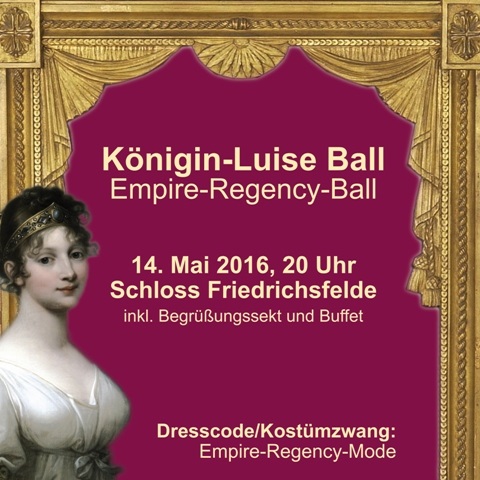
Königin-Luise-Ball - Empire-Regency-Ball

20 Uhr

Mitten im Tierpark Berlin, dem größten Landschaftszoo Europas, liegt das Schloss Friedrichsfelde. Die Veranstaltungen im frühklassizistischen Schloss Friedrichsfelde sind etwas ganz besonderes.

Das Schloss Friedrichsfelde entführt in die Zeit von Königin Luise von Preußen. Der Glanz und die Farbenpracht einer längst vergangenen Epoche werden neu erstrahlen.

Bei heiteren Tänzen des späten 18. und frühen 19. Jh. werden Sie an diesem Abend auf eine Zeitreise mitgenommen.

Der prunkvolle Festsaal und die Salons bieten eine eindrucksvolle Kulisse für diesen einmaligen Ball mit Livemusik. Das Abenteuer beginnt bereits mit der Wahl Ihrer Kleidung und den passenden Accessoires.

Eintritt: 45 Euro

Im Preis enthaltet ist ein umfangreiches Buffet und ein Begrüßungssekt.

Dresscode/Kostümzwang: Empire-Regency-Mode

Kartenverkauf: Tel. 030-51 53 14 07

Email. info@schloss-friedrichsfelde.de

und alle Vorverkaufskassen

Schloss Friedrichsfelde

Am Tierpark 41, 10319 Berlin

www.schloss-friedrichsfelde.de

Vorbereitungs-Workshop:

Freitag, 13. Mai 2016, 19 Uhr

Teilnehmergebühr: 10 Euro

  • Ball
  • 19th century
  • Regency