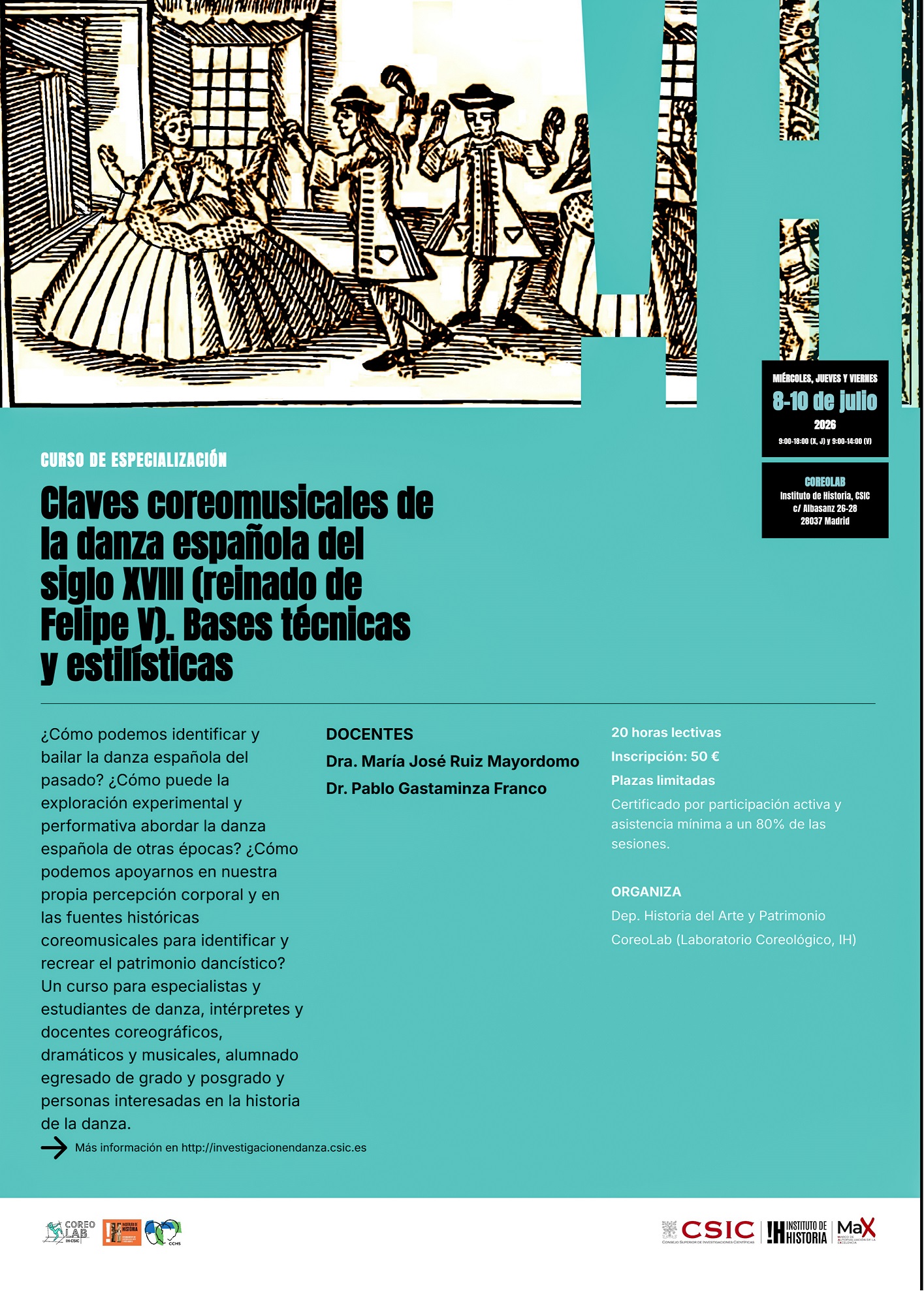
For the fourth consecutive year, course at CSIC-Coreolab. María José Ruiz Mayordomo together with PabloGastaminza Franco.
The Directors of ESQUIVEL (Danza&Música) will share the fruits of over 30 years of documentary and performative research. From July 8th to 10th.
This year's course is dedicated to 18th-century Spanish Dance (reign of Philip V).
It is the most direct antecedent of the Bolero Dance / Escuela Bolera, and therefore, the "paternal" great-grandfather of what, two centuries later, would evolve (within popular culture and "alternative" spaces) into what we know today as "Flamenco Dance," thanks to the knowledge passed down by our finest bolero dancers in academies, cafés, and other venues.
Online registration form: https://forms.gle/kPFDzHqSnSPdho196
How can we identify and dance the Spanish dance of the past?
How can experimental and performative exploration address Spanish dance from bygone eras?
How can we draw on our own bodily perception and historical choreographic sources to identify and recreate the Spanish dance heritage?
In the performing arts, and specifically within the so-called "Historicist Movement," 18th-century Spanish dance constitutes an essential link in the construction of the European dance narrative and, consequently, arouses profound interest among scholars and performers who approach it.
Eighteenth-century Spanish dance continued to contribute important elements, repertoire, and dynamics to the development of international academic dance, a theoretical and performative antecedent of what we now know as "Bolero Dance" (also called the Bolero School) and "classical ballet." Spanish dancers and dance teachers continued to develop a unique and characteristic language, repertoire, and style of dance, leaving a legacy of virtuosity and stylistic features that—along with fashion—would constitute kinetic and interpretive patterns still traceable today, associated with the Spanish-influenced repertoire.
The transmission of this choreographic and musical heritage remains in force, although both the repertoire and the stylistic and technical characteristics of that past have been forgotten, due to the conceptual and aesthetic evolution in the performing arts.
This specialization course, from a holistic experimental perspective, offers a critical, kinetic, and auditory approach to the historically informed interpretation of 18th-century Spanish dance heritage. It focuses on providing the tools, transdisciplinary foundations, and proprioceptive methods necessary to address this facet of Spanish dance studies.
The course employs a critical approach—both theoretical and practical—to the available documentation and testimonies. The practical and, secondarily, theoretical content will cover the fundamental choreographic and musical concepts of Spanish dance from the first half of the 18th century.
With this, the knowledge and skills acquired will serve researchers, dancers and students to address the study of Spanish dance of the 18th century (reign of Philip V), aimed at the generation and transfer of knowledge, kinetic and documentaryly informed, on Spanish historical choreographic heritage, along with the dissemination and enjoyment of the repertoire.

- Summer School
- Spanish baroque
- Intermediates
- Advanced
- Professionals

- Log in to post comments